By: Eric Hagerman, This Old House online
Making a Healthy Home
“Getting pregnant isn't always as easy as it looks on TV. Some 7.3-million American women have trouble becoming pregnant or staying pregnant. Doctors can't explain what's wrong for about 10 percent of the couples who can't conceive, and some experts suspect the culprit is all around us: environmental contaminants, particularly in the home.
That may help explain why male sperm counts are dropping, and it's a fact that the male contributes to infertility about 40 percent of the time. Toxins in your couch, vinyl floor, and other spots where you may have made attempts to expand your family could be throwing a wrench in your reproductive works. As much as we like to see home as a benevolent vessel of our dreams, the materials and chemicals they're made of and furnished with—from flame-retardant cushions to Teflon pans—can quash those dreams. Here's what to look for, and what you can do about it.”
Click here for the article
A lot of good mini subjects about household items to avoid. We have known most of their bad effects for other reasons. Now there are more reasons people wanting to have children should avoid them.
“Soy: Doesn’t Bring Joy” – This one that surprised me, worth reading.
Natural mattresses are not as hard to find as it may seem. They might not be readily available from your semi-local big box or discount furniture store. Our daughter has a natural mattress made from cotton, wool and latex. We bought it from USA Baby and didn’t need to look forever to find it. The mattress was in stock, the crib was ordered out.
Showing posts with label Green. Show all posts
Showing posts with label Green. Show all posts
16 January 2012


10 Ways Your House Can Kill You
By: Keith Pandolfi, This Old House online
Danger on the Homefront
"We love our homes. They provide us with warmth, shelter and, best of all, security. That's why it's so darn shocking when they turn against us. Like it or not, a house can be a virtual arsenal of lethal weapons. Whether its poisonous gasses, fiery flames, rabid bats or electrocuting appliances, even the sweetest Colonial Revival can be as armed and dangerous as Rambo on a bad day. Here are 11 ways our home sweet homes can take us down. “
Click here for the article
The most important but not obvious ones are:
“Mold” A lot of people don’t realixe how easy it is to get mold in your house. Even a very minor roof leak, say a few drops every time it rains, can cause mold to grow on the backside of drywall. Normal drywall is surfaced front and back with paper. Paper is the favorite food for mold. The unfortunate thing is it usually starts on the backside where you can’t see it. It virtually never disappears on its own. The drywall must be removed by professional mold abatement specialists. Not removing it could result in chronic illness.
“Chemically Packed Paint Fumes” Painting a home’s interior with just any paint that you buy off the shelf will be dangerous to your health If you pick the wrong one. That new paint smell*, which may make people notice that something was recently completely, could be causing health problems. When buying paint for your home make sure it is “Zero VOC” – Sherwin Williams uses the label “Harmony” to identify it. If “Zero VOC is not available either avoid that brand or supplier of interior paint or opt for “Low VOC”. I would still avoid “Low VOC” whenever possible due to the fact that “Low” essentially means it will only irritate you a little bit. Also improperly storing non-“Zero VOC” paint can lead to health problems too. In one situation several years ago I looked at a house for sale that was newly painted inside. The realtor was proud to point out that the seller just completed painting all the rooms. Unfortunately the smell from the off-gassing was so bad that my sinuses were swelling up and burning. I would never consider buying that house.
*This new paint smell applies to other things. The new car smell is usually not healthy as it is off gassing of dangerous chemicals. For instance Volkswagen’s interiors are made from Zero and Low VOC materials. That is the reason that their cars have almost no new car smell. Some other competitors do not take the step to care about the issue but fortunately more are catching up.
Golden Rule to VOC’s: If it has, or is made from, petroleum based chemicals, it is dangerous to your health at some level.
Danger on the Homefront
"We love our homes. They provide us with warmth, shelter and, best of all, security. That's why it's so darn shocking when they turn against us. Like it or not, a house can be a virtual arsenal of lethal weapons. Whether its poisonous gasses, fiery flames, rabid bats or electrocuting appliances, even the sweetest Colonial Revival can be as armed and dangerous as Rambo on a bad day. Here are 11 ways our home sweet homes can take us down. “
Click here for the article
The most important but not obvious ones are:
“Mold” A lot of people don’t realixe how easy it is to get mold in your house. Even a very minor roof leak, say a few drops every time it rains, can cause mold to grow on the backside of drywall. Normal drywall is surfaced front and back with paper. Paper is the favorite food for mold. The unfortunate thing is it usually starts on the backside where you can’t see it. It virtually never disappears on its own. The drywall must be removed by professional mold abatement specialists. Not removing it could result in chronic illness.
“Chemically Packed Paint Fumes” Painting a home’s interior with just any paint that you buy off the shelf will be dangerous to your health If you pick the wrong one. That new paint smell*, which may make people notice that something was recently completely, could be causing health problems. When buying paint for your home make sure it is “Zero VOC” – Sherwin Williams uses the label “Harmony” to identify it. If “Zero VOC is not available either avoid that brand or supplier of interior paint or opt for “Low VOC”. I would still avoid “Low VOC” whenever possible due to the fact that “Low” essentially means it will only irritate you a little bit. Also improperly storing non-“Zero VOC” paint can lead to health problems too. In one situation several years ago I looked at a house for sale that was newly painted inside. The realtor was proud to point out that the seller just completed painting all the rooms. Unfortunately the smell from the off-gassing was so bad that my sinuses were swelling up and burning. I would never consider buying that house.
*This new paint smell applies to other things. The new car smell is usually not healthy as it is off gassing of dangerous chemicals. For instance Volkswagen’s interiors are made from Zero and Low VOC materials. That is the reason that their cars have almost no new car smell. Some other competitors do not take the step to care about the issue but fortunately more are catching up.
Golden Rule to VOC’s: If it has, or is made from, petroleum based chemicals, it is dangerous to your health at some level.
28 February 2011
It's Offical - Fiat is Back!

Yes, those are U.S. flags and the Fiat logo and yes it is a Fiat Dealership Studio. This is Bergstrom Fiat in Milwaukee one of three dealerships open in the U.S. The other two are in Los Angeles and Washington D.C. In addition to these there will be 180 more dealerships opening this year. There is a bit of irony here because that is a former Hummer Dealership that closed due to lack of sales and the pending GM bankruptcy. Now the building will be selling cars that have fuel economy of up to 40 m.p.g. and amongst the lowest polluting cars sold in the U.S. Fiat stopped importing cars in 1982. In 1992 VW almost stopped but instead gave it one more try and succeded - VW is now the world's second largest producer of automobiles and is narrowing in on Toyota. Hopefully the re-entry into the U.S. will help Fiat in world wide sales. Fiat now owns 20% of Chrysler and will own 35% by the end of 2011. Fiat, without Chrysler and not selling cars in the U.S., ranks sixth largest and if Chrysler is counted in the next two years it should be fourth behind Ford.
It is wonderful being in Milwaukee and being one of the first open. Fiat had mentioned that the Midwest was the last region of the U.S. to get the cars (we buy more domestics than the other areas of the country). But the new Fiat 500 is not entirely an "import". It is built in North America and technically a Chrysler Group car. I could explain why but to do so would need much more time with an all new blog post that would be longer than this one. The engine and transmission are assembled in Michigan and final assembly is in the Chrysler plant in Toluca, Mexico.
 |
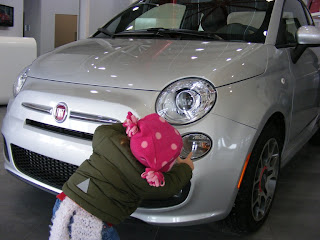
| Look Daddy! Its baby Fiat car!!! (She is frozen there and too excited to get close to it) |
 |
| Baby Fiat Car! Baby Fiat Car! Baby Fiat Car! |
 |
| This is baby Fiat car eye... |
 |
| this is baby Fiat car nose... |
 |
| and what's this daddy? |
 |
| Beep! Beep! |
 |
| Baby Fiat Car goes Vroom! Vroom! |
 |
| Baby Fiat car is happy daddy. |
 |
| She was speachless about the rear end - just screamed for joy. |
17 November 2010
Fiat Cinquecento Unveiled to North America Today

Today is the day that Fiat Officially announces its return to the United States. The U.S. version of the Fiat 500, a.k.a. Cinquecento, was debuted at the L.A. International Car Show. The car will be showing up at dealerships, called Fiat Studios, in December and will be available for sale in January. Fiat also sent out letters of intent to 150 dealerships that applied for franchises. Within the Fiat information released is that the EPA fuel economy

ratings for "City" and "Combined" ratings will exceed 40 m.p.g. I am excited to see that the Fiat USA website has pricing, build configurations and Fiat paraphernalia. More information is available on Facebook and Youtube. Fiat has indicated that more versions will be available in the next two years. They include convertible, four door people mover, and full electric power (already available in Europe).


05 August 2010
Lorelei's House Hunting Adventures

"Daddy, the front storm door needs to be replaced - just look at that aluminum corrosion near the bottom. I think we should get a wood one, it will last longer. Also the bleach blonde flush solid core door is completely inappropriate for the Craftsman style entry. And by the way, did you get a picture of that crack in the foundation wall?"
27 July 2010
Principles of Urban Design
The following is copied from the City of Milwaukee's Website. It is a good, breif explanation of what has been called a lifestyle to many, a demographic trend movement to others and essentially the correct way to live for most of us humans. Although this is in Milwaukee's website it is not just about Milwaukee, these are principiles that are shared and embraced amonst most urban centers. Also many of our suburbs enjoy these qualities - suburbs such as, but not limited to, Wauwatosa, West Allis, Cudahy and Whitefish Bay. From my house I can walk to Lake Michigan, a marina, South Shore Park, Humbolt Park, retail shops (like Outpost, Rushmor, etc.), restaurants, coffee shops, bakeries and banks. I can also walk to a few bustops, one of which is the #15 that will go to north to Bayshore, past UWM, through Downtown and all the way South to South Milwaukee. The four Principles of Urban Design are as follows:
Introduction
Cities possess a singular appeal. The proximity of people and activities in cities facilitates efficient use of land and transportation systems and creation of convivial public spaces. Milwaukee must encourage development of housing, commerce and transportation systems that embrace its urban heritage. The city must recognize its unique assets and build upon its strength as the core of a major metropolitan area.
 |
| Milwaukee County Library - Central Branch |
Coordinated planning and development effectively integrate many elements. Quality housing that enhances a sense of community among neighborhood residents; attractive customer-friendly commercial streets; greenspace offering recreational amenities and a diverse array of transportation options represent only a few of the many elements that, when well designed, contribute to good urban form. Milwaukee must promote urban design practices that emphasize the public qualities of buildings and creation of places with lasting value and civic meaning.
New buildings should be designed in ways that retain the traditional qualities of Milwaukee’s architecture. This does not mean that new buildings should nostalgically imitate historical styles. In fact, to do so would be contrary to the creative design traditions that produced Milwaukee’s rich architectural legacy. Timeless design principles should be followed that produce architecture that fits with its context and is human scaled. New buildings should be designed to be compatible with neighboring structures, spaces and activities. Visually interesting and human-scaled building facades should prevail over sterile, windowless walls - especially when facing public spaces.
Diversity is the city’s unique strength. The rich mix of uses found in Milwaukee’s neighborhoods provides convenience, vitality and individual identity. The transportation network binds the city together. Milwaukee must be organized around a transportation network that offers mobility choice. Needs of pedestrians and automobiles should be balanced to create a legible, walkable and memorable public realm.
Combining good design with the city's rich architectural heritage will maintain its unique, attractive, "people-friendly" environment and further enhance Milwaukee’s residents' quality of life.
The following design principles articulate those unique qualities that characterize Milwaukee’s neighborhoods, and are meant to promote development and redevelopment that reinforce and preserve these characteristics.
Principle #1: neighborhood compatibilityA cohesive neighborhood environment depends on buildings that compliment one another. The size, shape and location of buildings as well as the uses contained within them, create "patterns" that define neighborhood character. New development should be compatible with the pattern of its surrounding context.
Development that adheres to this principle will:
A. Relate to the physical character and scale of the neighborhoodB. Enhance linkages to surrounding uses, especially public services and amenities (schools, parks, mass transit)
Principle #2: pedestrian friendly design
Cities are for people, and an environment designed to accommodate the pedestrian heightens human experience and sense of place. New development should be designed to create attractive, comfortable and safe walking environments.
Development that adheres to this principle will:
A. Locate buildings to define street edges and corners
B. Enliven street frontages to enhance the pedestrian experience
C. Create memorable places for people
Principle #3: land use diversity
Many Milwaukee neighborhoods are comprised of a rich mix of land uses. Such diversity uses land efficiently, provides for neighborhood convenience and contributes to unique urban experiences.
Development that adheres to this principle will:
A. Encourage a compatible mix of uses at the neighborhood scale
B. Identify opportunities for shared uses
Principle #4: transportation diversity
Milwaukee’s neighborhoods are connected by a functional circulation network of streets and blocks. This system should be maintained and improved in ways that accommodate various modes of transportation balanced with needs for pedestrians.
Development that adheres to this principle will:
A. Create a balanced circulation system that accommodates mobility choice (pedestrians, automobiles, bicycles and transit)
B. Enhance public transportation by making it more comfortable and convenient to use
 |
| City of Milwaukee, 1898 |
09 February 2010
Official Site for World Wide Climate Data from NOAA - climate.gov
A prototype web site has been launched by our Federal Government to allow us average folks access to an incredible amount of climate data from around the world. Information available ranges from historic data to current data and also provides predictions. Normally information such as this would require research and special access via professional, govermental or educational permission. The subject tabs include "Climate Watch Magazine", "Data & Services", "Understanding Climate", and "Education". You can browse the Global Climate Dashboard, News, Videos and Images. All the information that you need to fatten your brain sponge and be the life of the party! Or great browsing for that rainy day lunch at the office. Or better yet, include data in your own research and improve you products and projects.
10 December 2009
Diesel Electric Hybrid! Finally They are Planning for Them

LA Auto Show 2009 Volkswagen-Up-Lite Photo Courtesy Road & Track
I have proposed them for the last several years and could not understand why nobody was developing them for cars. We see diesel electric hybrids in operation for over fifty years - they are diesel locomotives that exclusively power our modern day trains. Something nice about diesel electric hybrid cars is that the fuel does not have be a petroleum product. They can run on biodiesel made from used fryer oil and at 70 mpg you won't need a lot of that. My proposed car is actually propelled by (proprietary information not to revealed) similar to train locomotives.
There are "plug-in" electric cars proposed by some car manufacturers (and a few currently available) but these are usually a worse environmental choice than a car with really low fuel consumption. The reason for that is the majority of electricity available in the U.S. is produced from coal or gas. The quantity of noxious emissions created by the electricity generated to charge the batteries for an electric car is larger than the quantity of emissions from the average gas powered car (for coal or gas sourced electricity). Unless the "plug-in" electric car gets its electricity from a safe renewable source (i.e. solar, wind, hydro electric), there is a negative environmental impact. The only good point is the emissions of the plug-in car are zero, but the power plant will be spewing a higher quantity of emissions.
So, before buying an electric only car or an electric hybrid car, really research the information including where that electricity does come form to power that plug-in electric car that you may consider. Also research the batteries.
02 December 2009
Correction - Big Ed
Correction - The now former GM CEO Fritz Henderson is not "Big Ed the Texan" who publicly proclaimed he knows nothing about cars - that is Ed "Big Ed" Whitaker. Big Ed IS the Chairman of the Board of GM and now the interim CEO. Big Ed is the former CEO of AT&T whom is responsible for the current organization of it. Fritz Henderson was a life long GM employee/executive whom apparently could not shake off his GM family and atmosphere fast enough to satisfy the Board. Just a note, I read a recent story saying that AT&T has earned the status of having possibly the worst customer service this year (of any service providing company - not just phone). Big Ed was instrumental in setting up the current AT&T corporate hierarchy - that was listed as his greatest achievement to date.
Why do I update people on the status of GM? This is supposed to be a blog about architecture, urban community and environmentally friendly living. As one of the largest manufacturers of automobiles and other transportation vehicles, GM has probably the worst environmental track record of any its competitors. It has to be ordered by federal and state governments to clean up its act. It is now marketing itself as "green friendly" (see green washing definition) because it is trendy. Its lobbyists fight all types of governmental laws aimed at improving fuel economy, reducing emissions and increasing public transportation. If GM were truly concerned it would quickly address these issues and prove that it can exceed any proposed government regulations instead of fighting them. The choice, eight months ago, to hire Fritz Henderson as CEO and Big Ed the Texan as Chairman were amongst those bad GM decisions - no matter who made the decisions. GM and a few other large corporations are fighting against ideals that are important in this blog.
Why do I update people on the status of GM? This is supposed to be a blog about architecture, urban community and environmentally friendly living. As one of the largest manufacturers of automobiles and other transportation vehicles, GM has probably the worst environmental track record of any its competitors. It has to be ordered by federal and state governments to clean up its act. It is now marketing itself as "green friendly" (see green washing definition) because it is trendy. Its lobbyists fight all types of governmental laws aimed at improving fuel economy, reducing emissions and increasing public transportation. If GM were truly concerned it would quickly address these issues and prove that it can exceed any proposed government regulations instead of fighting them. The choice, eight months ago, to hire Fritz Henderson as CEO and Big Ed the Texan as Chairman were amongst those bad GM decisions - no matter who made the decisions. GM and a few other large corporations are fighting against ideals that are important in this blog.
01 December 2009
Definition: Greenwashing
Greenwashing (green whitewash) is the practice of companies disingenuously spinning their products and policies as environmentally friendly, such as by presenting cost cuts as reductions in use of resources.[1] It is a deceptive use of green PR or green marketing. The term green sheen has similarly been used to describe organizations that attempt to show that they are adopting practices beneficial to the environment.[2]
Definition of "Greenwash/Greenwashing" from Wikepedia
Link to site: Greenwashing Index, evaluate and news
Definition of "Greenwash/Greenwashing" from Wikepedia
Link to site: Greenwashing Index, evaluate and news
25 November 2009
30 August 2009
Healthy Living and Working 1
Today’s media has picked up on the new term “Green”. In the 1980’s the word green was always associated with a color. Now when someone mentions green people usually think about things that are good for the environment. It is seems that the marketing gurus all over the nation have decided that it is trendy to be “Green”. You can now buy such things as eco friendly “Green” disposable plates. Or you can buy “Green” (partially recycled) PVC decking for your back porch.
Being “Green” does not mean going to the store to buy anything labeled “green” just because some marketing team decided that it had recycled content in it. Being green is all about lifestyle. If you are truly concerned about the environment you will never buy disposable dinnerware. You will also not purchase PVC anything for your house. Going back to those first days of environmentalism of the 1970’s, I remember all those little things I learned in school and I have built upon that with all my life decisions. In the future I hope to write topics that will enlighten everyone on how to be environmentally responsible in the built environment. Keep checking back…
Being “Green” does not mean going to the store to buy anything labeled “green” just because some marketing team decided that it had recycled content in it. Being green is all about lifestyle. If you are truly concerned about the environment you will never buy disposable dinnerware. You will also not purchase PVC anything for your house. Going back to those first days of environmentalism of the 1970’s, I remember all those little things I learned in school and I have built upon that with all my life decisions. In the future I hope to write topics that will enlighten everyone on how to be environmentally responsible in the built environment. Keep checking back…
Subscribe to:
Posts (Atom)

